


 MENU
MENU


Neumann M 50 – From the 20th Century to the Present Day.

There are microphones that became successful, and there are microphones that shaped the very sound of recording itself. The Neumann M 50 belongs unequivocally to the latter category. It is not merely another “vintage reissue” for collectors, nor a historical curiosity. It is a microphone that has defined how orchestras, concert halls and symphonic works have been heard for more than seven decades. Today, it returns not as an exercise in nostalgia, but as a statement of precision and continuity. Not to recall the past, but to remind us what proper recording truly means.
In this article, we examine the M 50 in depth, following a timeline that begins with its origins and extends to the present day. As a microphone synonymous with classical music recording, the M 50 stands out not only for its history, but also for its unique technology, its close relationship with the Decca Tree technique, and its contemporary revival as the M 50 V. At a time when the concept of fidelity is being redefined, the M 50 remains a reference point for what accuracy in recording genuinely represents.
A Return with Meaning, Not with Noise
The reappearance of the Neumann M 50 was not accompanied by spectacular launches or marketing fanfare. Instead, the German manufacturer chose a discreet, almost introspective approach, introducing the microphone in 2023 as the M 50 V, directly to the professional audio community. This decision is far from accidental; it clearly reflects the positioning of the M 50 as a reference tool rather than a product aimed at mass consumption.
This is not a nostalgic revival, but a deliberate return of a microphone intended for those who know precisely what they seek from a recording and are prepared to take responsibility for accuracy. With this stance, Neumann itself reminds us that the M 50 does not need to be “introduced” — it simply needs to be heard.
The Era That Gave Birth to the M 50
To understand the historical significance of the Neumann M 50, one must turn back to the late 1940s. Europe was attempting to rediscover its voice after the war, while classical music recording was undergoing a fundamental redefinition. The demands were clear yet extraordinarily challenging: not merely the capture of musicians, but the reproduction of space, scale and natural perspective.
Georg Neumann GmbH* recognised early on that the future of classical recording did not lie in close, narrow microphone placement, but in a microphone’s ability to “see” the hall as the human ear does — and perhaps even slightly better. The result of this philosophy was the M 50, a microphone conceived from the outset not as a general-purpose tool, but as a precision instrument for large acoustic ensembles.
*Georg Neumann GmbH was founded in Berlin in 1928 by Georg Neumann, a pioneering audio engineer, and is globally renowned for its high-quality condenser microphones. The company has played a decisive role in the history of recording through numerous technical innovations.
A Unique Design: The Sphere That Changed Everything
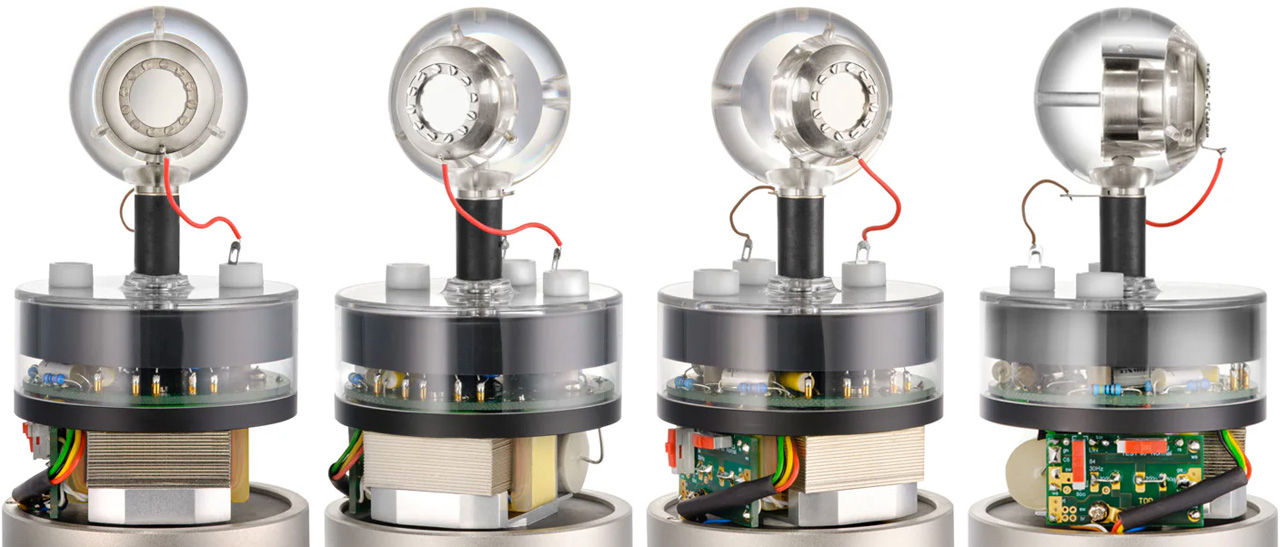
The uniqueness of the M 50 lies not simply in its valve or its capsule, but in their combination with a spherical head approximately 40 mm in diameter. The capsule (type M7) is housed within this sphere, creating a highly distinctive polar behaviour: a largely uniform acoustic capture at low frequencies, with gradually increasing directivity in the higher range.
This phenomenon is anything but accidental. It is precisely controlled and forms the key to the way the M 50 captures space. Low frequencies convey the volume and body of the hall, while higher frequencies preserve clarity, focus and localisation. The result is a sound that does not cling to the loudspeakers, but instead opens the space in front of the listener.
The Decca Tree and the Role of the Neumann M 50
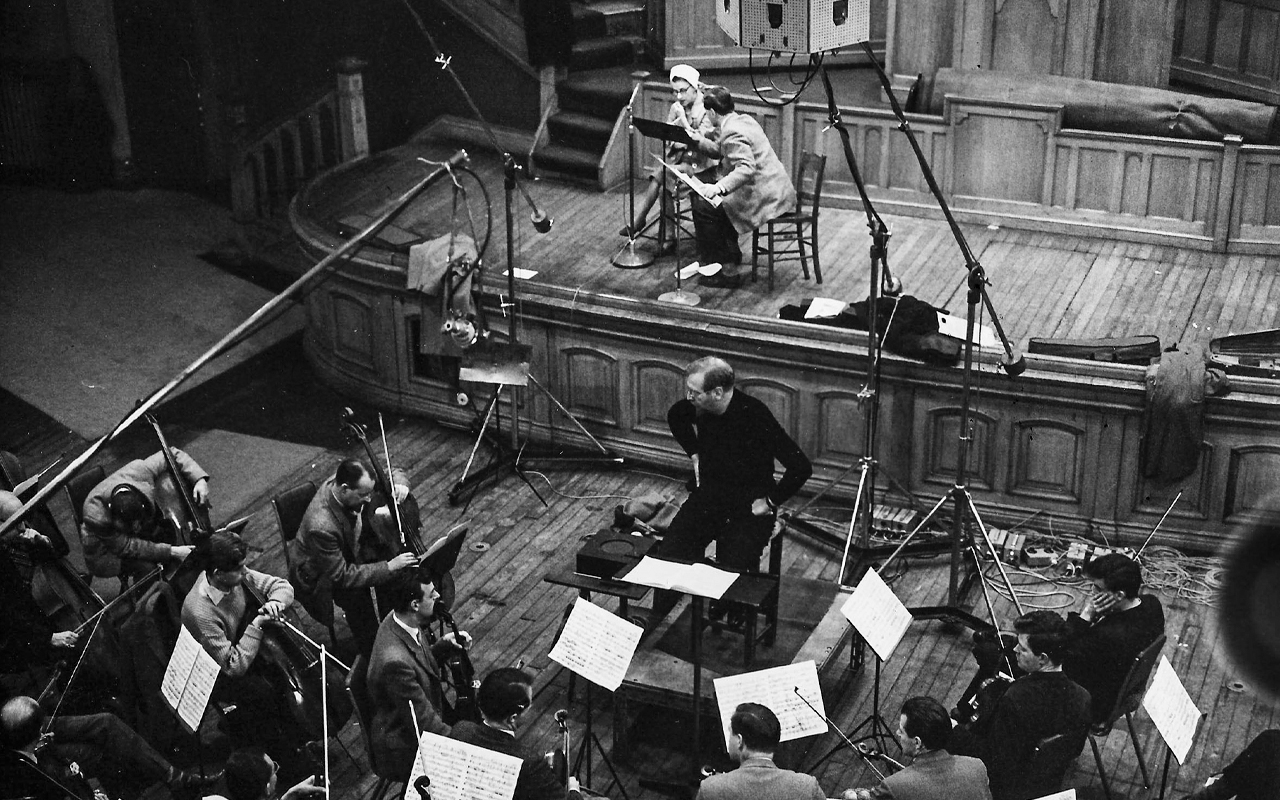
The story of the Neumann M 50 is inseparable from the Decca Tree, the iconic main orchestral microphone technique developed by engineers at Decca Records* in the 1950s. The configuration employs three microphones with uniform spatial response, arranged in a precise triangular formation above the conductor, aiming not merely for stereo imaging, but for an accurate rendering of space, scale and the orchestra’s natural perspective.
The M 50 proved ideally suited to this philosophy. Its distinctive behaviour — broadly uniform at low frequencies and more focused at higher ones — enabled depth and clarity without artificial intervention. Through the Decca Tree, the M 50 did more than record music; it helped shape the way we continue to hear great symphonic recordings to this day.
*Decca Records was founded in 1929 by Edward Lewis and is one of Britain’s most distinguished record labels, renowned for its pioneering role in high-fidelity, classical and popular music recordings.
Why the M 50 Became a Legend
Unlike other vintage microphones that gained fame through character or tonal “colour”, the M 50 became legendary for almost the opposite reason: it does not impose itself on the music. Engineers trusted it because it concealed nothing. It did not beautify poor acoustics, nor did it soften reality. If the hall was good, the M 50 elevated the recording; if it was not, the microphone revealed it without mercy.
This degree of honesty is precisely why the M 50 was never a mass-market product. It was always a tool for those who knew exactly what they were doing.
The M 50 does not forgive. It does not rescue poor placement, nor does it mask the shortcomings of a space. Instead, it demands decision-making, experience and acoustic judgement from the engineer. Those who choose it understand that the success or failure of the recording will be captured without filters — and it is this very demand that transforms the M 50 from a simple tool into a reference point.
Silence and Return
As the decades passed, production of the M 50 ceased. Original units became rare, expensive and almost mythical. For years, the microphone existed only in archives, museums and a handful of carefully guarded studio collections. Neumann’s decision to bring it back as the M 50 V was neither simple nor accidental. It was not a retro marketing gesture, but a technically demanding reconstruction of a design that allows no compromise.
For decades, the M 50 remained a benchmark without replacement. The scarcity of original units and the complexity of its construction made any revival exceptionally difficult. Neumann’s decision was not driven by nostalgia, but by the need to preserve a particular way of listening to and capturing space — one that risked being lost.
Neumann M 50 V: Today, with Respect for Yesterday
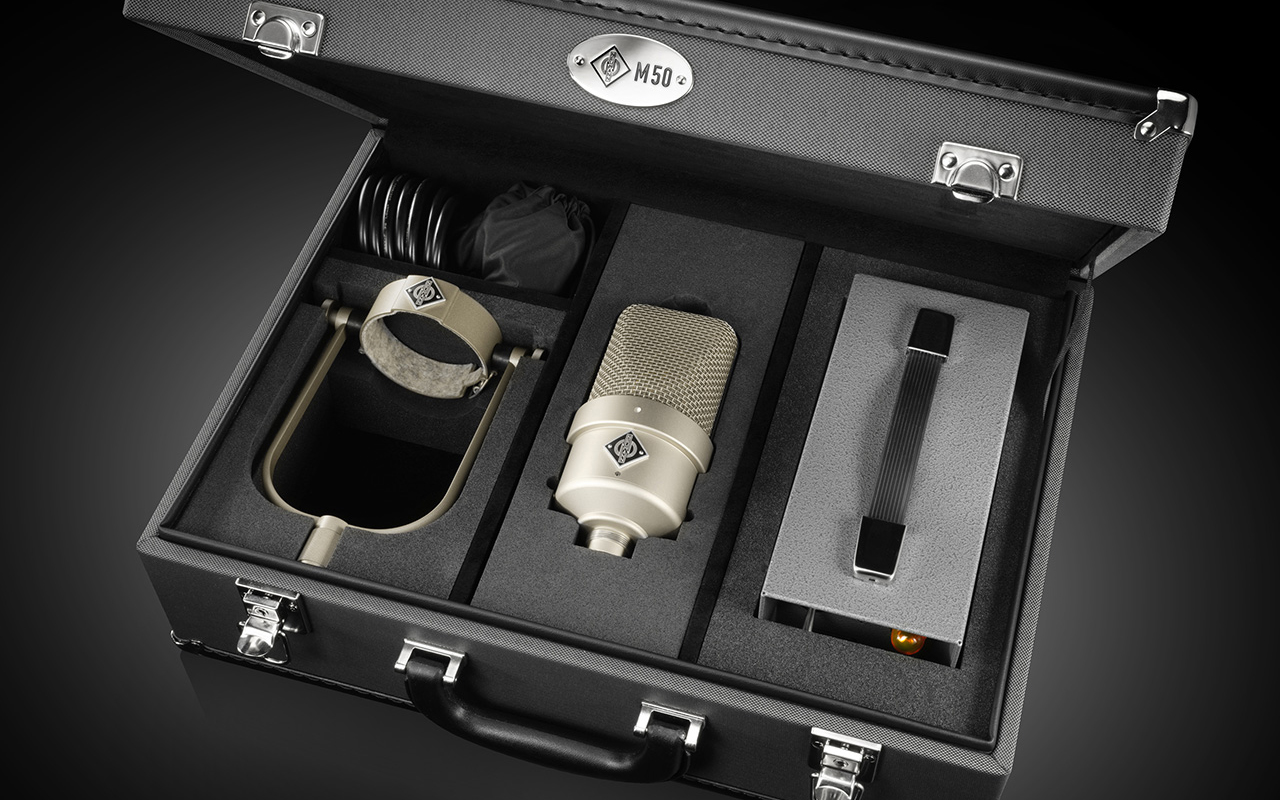
The M 50 V is, in essence, the closest possible revival of the original M 50. A carefully selected and adapted VF14k valve, handcrafted construction in Germany, rigorous quality control — and, of course, the distinctive spherical head.
Neumann did not attempt to “modernise” the sound. On the contrary, the objective was to preserve spatial behaviour, a far more complex task than merely replicating frequency response. The M 50 V is not intended for everyone. It is aimed at classical music engineers, scoring stages, high-end orchestral productions and demanding immersive applications such as Dolby Atmos and Auro-3D.
See all M50 features here
The M 50 in the Contemporary Recording World
In an era where technology enables extensive processing and post-production correction, the Neumann M 50 consciously moves against the current. It reminds us that correct capture, proper placement and informed acoustic decisions remain superior to any plug-in. This is not a microphone that can be “saved” in the mix; it demands that you know, from the outset, what you are listening for and why.
From the Concert Hall to the Cinema
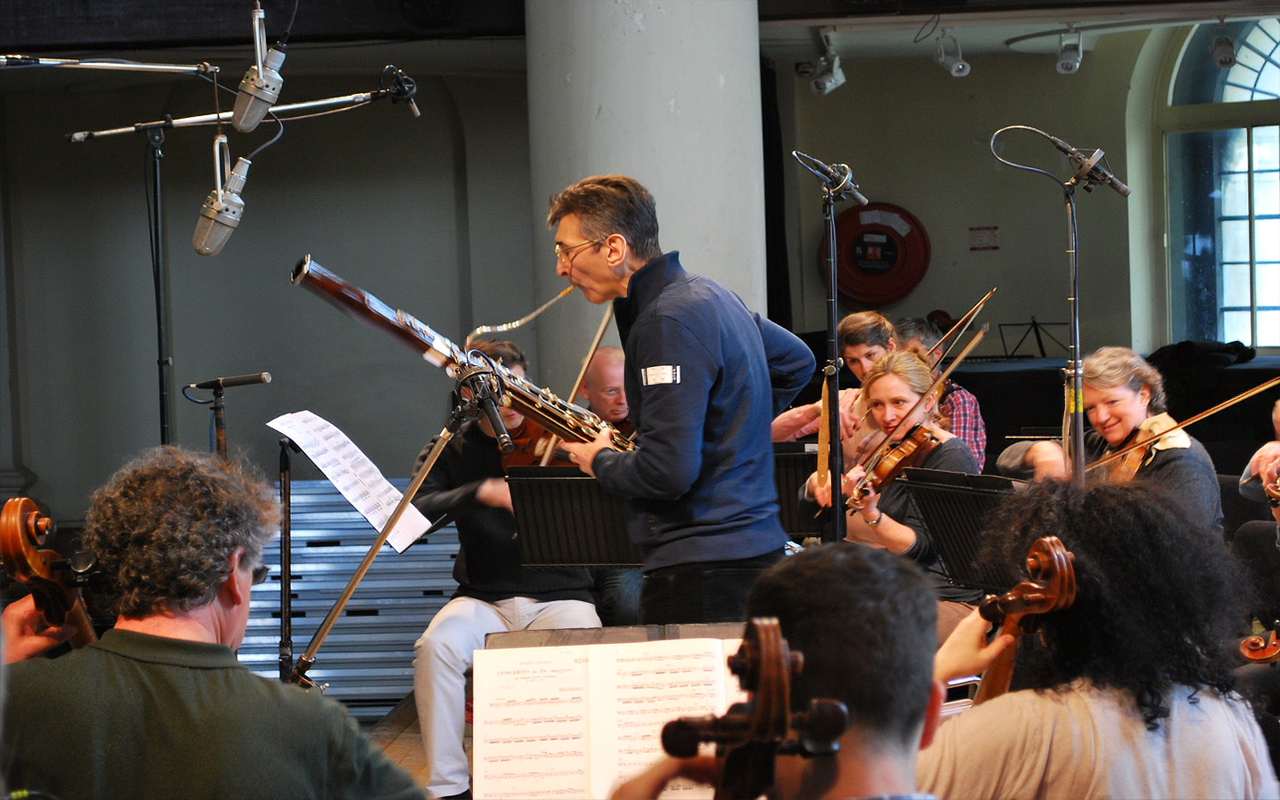
The enduring value of the Neumann M 50 is also evident in modern film music, where the need for natural scale and spatial accuracy remains unchanged. In large orchestral film recordings, the Decca Tree configuration with M 50 microphones continues to serve as a reference. A notable example is the recording of Howard Shore’s award-winning score for The Lord of the Rings trilogy, performed by the London Philharmonic Orchestra at Abbey Road Studios. There, the M 50 was used as a principal tool for capturing the orchestra, contributing to a sonic result that combines weight, depth and cinematic drama.
The continued use of such techniques in contemporary orchestral and scoring sessions demonstrates that the M 50 does not belong to the past; it continues to serve demanding, high-level productions.
See all Neumann products here
More Than a Microphone
The Neumann M 50 is more than a piece of equipment. It is a lesson in acoustics, a reminder of discipline, and a symbol of an era in which technology served music — not the other way around. Its return as the M 50 V is not about nostalgia, but about the continuity of accuracy in a world that needs it more than ever. For those working with sound at the highest level, the M 50 is not a legend of the past, but a reference tool — then, now and for many years to come.
Read everything you need to know about professional microphones in our Buyer's Guide.
Athens Pro Audio Team ©
Recent Articles
-
![AWOL Vision Aetherion MAX - Real cinema display!]()
AWOL Vision Aetherion MAX - Real cinema display!
-
![Cartridge or Phono Stage: Which Should You Upgrade First!]()
Cartridge or Phono Stage: Which Should You Upgrade First!
-
![Focal Diva Alta Utopia – When High-End Audio Stops Being Complicated.]()
Focal Diva Alta Utopia – When High-End Audio Stops Being Complicated.
-
![Leica Cine Compact 1 - A New Level of Freedom in Home Cinema.]()
Leica Cine Compact 1 - A New Level of Freedom in Home Cinema.
-
![Focal Mu-so Hekla – The new era of all-in-one sound by Focal & Naim.]()
Focal Mu-so Hekla – The new era of all-in-one sound by Focal & Naim.
-
![Audeze Maxwell 2 – High-Fidelity Sound in Gaming]()
Audeze Maxwell 2 – High-Fidelity Sound in Gaming
-
![7+1 smart ways to truly upgrade your sound.]()
7+1 smart ways to truly upgrade your sound.
-
![Neumann M 50 – From the 20th Century to the Present Day.]()
Neumann M 50 – From the 20th Century to the Present Day.
-
![Fender Studio Pro: The Next Day of Studio One Is Here!]()
Fender Studio Pro: The Next Day of Studio One Is Here!
-
![Naim New Classic 300 Series - Redefining Your Very Own Legacy.]()
Naim New Classic 300 Series - Redefining Your Very Own Legacy.
-
![HiFi Rose RS130 - The Art of Digital Sound!]()
HiFi Rose RS130 - The Art of Digital Sound!
-
![Open Day - Christmas Dream of Sound | Focal Powered by Naim Athens!]()
Open Day - Christmas Dream of Sound | Focal Powered by Naim Athens!


Follow us on Social Media
Don't miss out on new products and events by Athens Pro Audio.




